At seventy-three, I sat there watching my son’s family eat steaks while his wife placed a cold piece of yesterday’s meat on my plate.
That night, I found a letter.
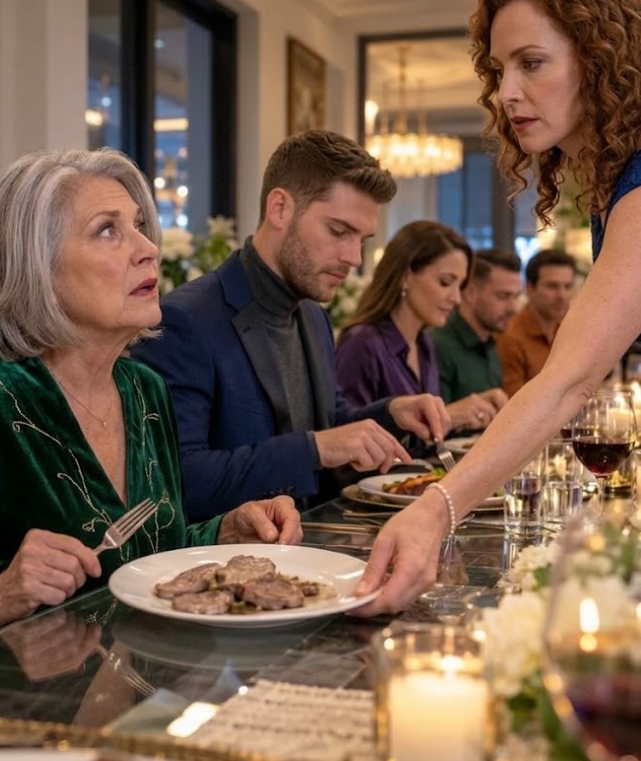
Madison did not set my plate down until everyone else had already started eating.
Daniel had a large, juicy steak in front of him, just like his wife and the guests seated around the long glass table.
On my plate was a thin slice of meat with hard, gray edges.
When I touched it with my fork, it was cold.
I looked at Madison, hoping there had been some mistake, but she was already reaching for one of the guests’ wine glasses.
I was seventy-three years old — old enough to understand that being invited to dinner does not always mean you are truly welcome.
Even so, I had driven across Los Angeles because my son called me that afternoon and said:
“Come over, Mom. We want to see you.”
An extra chair had been added for me at the end of the table.
There was no napkin at my place, and my glass of water was the only one without wine.
Daniel laughed at one of the guests’ jokes about a trip to Napa.
For a moment, I heard in his voice the little boy who used to take me to the beach in Santa Monica so I could watch him run through the waves.
But now there was a grown man sitting in front of me.
Every time Madison said something, his smile tightened and his attention returned to the guests.
I had come hoping I would get the chance to talk with him.
But at that enormous table, fourteen feet of glass separated us, along with a flower arrangement so large a person could have hidden behind it.
They talked about renovating the house and possibly taking a trip to Napa.
I knew exactly how much the private school Lily and her younger brother attended cost because I was the one paying the tuition.
When their car broke down, I helped them buy another one.
And while Daniel told the guests how they managed to “do so much for the children,” I forced myself to swallow the cold meat.
Lily looked at me only once.
She was an observant girl and always noticed when someone suddenly became quiet.
I saw her glance at my plate.
Madison touched her shoulder and redirected her attention back to the conversation.
I gave Lily a small smile so she would not feel responsible for fixing something between the adults.
I had played that role myself for far too long.
I barely spoke for the rest of dinner.
Madison served dessert to the guests first.
I received a small slice last.
It sat in the middle of an almost empty plate.
I could have made a scene.
But pretending the problem was only the dinner would have been pointless.
I thanked Madison when she took my plate away.
Partly out of habit.
And partly because I needed to hear just how automatically I still said that word.
At the door, Daniel was looking at his phone.
“Drive home safely, Mom,” he said.
He did not even ask whether I had enjoyed myself.
I told him everything had been fine.
As I walked toward my old car, I nearly turned around and asked him why he had invited me in the first place.
Instead, I got in and spent several minutes staring at the brightly lit windows of the Santa Monica house I had once helped him buy.
Charles and I had taught Daniel to say “thank you” when someone handed him even a glass of water.
After my husband died, I found it harder and harder to understand what my son truly needed and easier and easier to agree to pay for whatever he asked for.
His grief was real.
But so were the overdue rent payments I covered, the debts from his first failed business, and the down payment on that house.
We called the down payment a loan.
No one had mentioned in years when it was supposed to be repaid.
Then came the expenses for Lily and her brother’s school, the family car, and the nanny for those months when Madison said she could not manage two children on her own while Daniel’s career was doing better and better.
Some of that help truly had been necessary.
I was glad the children had everything they needed.
But gradually, I stopped asking myself when temporary hardship had turned into a family budget that I was, in practice, funding.
For many years, I worked as a financial controller for a logistics company.
I monitored payroll and demanded an explanation for every expense I did not understand.
At home, however, I was much less firm.
Every transfer I made to Daniel had a simple explanation:
He was my son.
Whenever Madison called and said some bill urgently needed to be paid, I transferred the money and told myself that love did not need receipts.
When I got home, I boiled some water and sat down at the kitchen table Charles and I had bought when Daniel was still small.
I thought about the missing napkin at Madison’s table and then about the mortgage payment I had covered the month before.
I went into my small home office and took a folder down from the shelf.
Every document was organized by year.
It was a habit I had kept from my working days.
Inside the folder were school invoices, bank transfer confirmations, insurance papers, and notes about which payment Daniel had promised to take over next time.
The amounts were significant.
But those were not what made me sit still for a long time.
At the back of the folder was a printed letter I had received two weeks earlier and, for some reason, had not yet had the courage to use.
Daniel had been asking how one of my investment accounts could be converted into a joint account that he would be able to access.
He had not asked me directly.
He had gone to someone else to find out how it could be done, and somehow the message containing the details had been sent to an email address I rarely checked.
I printed it and tucked it into the folder because I wanted to believe there was some innocent explanation.
Now I read the letter again while still thinking about the previous night’s dinner.
Daniel was not simply assuming I would continue paying his family’s bills.
He was looking for a way to gain access to my savings.
I did not know whether he planned to talk to me first or whether he had already taken steps.
But one thing I knew for certain: I had never agreed to give anyone shared access to my investments.
So before sunrise, I got dressed, picked up the folder, and drove to the bank.
Charles used to take me to the pier on Saturday mornings when Daniel was still little and loved having the nearly empty beach to himself.
As I waited for the bank to open, I remembered how Charles used to bring coffee in a thermos and almost always forget the cups.
He was a wonderful man and a terrible organizer when it came to beverages.
At the bank, I asked to speak with Sofia Morales, a senior adviser I had met before.
Sofia remembered me and invited me into her office.
She listened calmly without trying to explain that “families are just like that sometimes.”
I was grateful for that.
She reviewed every payment.
Some money was regularly going to accounts that were not mine. A few cards had been shared for so long that I could no longer remember whose name they had originally been issued under.
Sofia explained which payments could be stopped immediately and which would require additional paperwork.
I asked her to begin with every recurring payment I had personally authorized and to temporarily freeze the shared cards.
My hand was steady when I signed the first document.
On the second, I thought about Daniel opening a bill soon and discovering that I was no longer paying it.
Part of me wanted to call him first, explain the situation, and give him time to prepare.
Then I remembered that he had been asking questions about my investments without even deciding it was necessary to speak to me.
I signed.
A little later, Sofia returned to her computer and checked my investment account again.
Suddenly, her expression changed.
“Helen, did you try to log into the system this morning?”
I told her I had been at home getting ready to come to the bank.
She looked at the time.
“At 5:42 a.m.”
Sofia turned the screen toward me.
Someone had not only tried to log into my account.
A preliminary request had also been created to withdraw a large sum from my investment account.
I looked at the numbers and then at the printed letter lying beside me.
The screen did not show exactly who had submitted the request.
But one thing was clear: someone had tried to access my money.
“Can you stop it?” I asked.
Sofia said the security system had flagged the transaction and the money had not been released.
I asked her to completely block access to the account, change the security settings, and formally document the entire incident.
She started working while I kept staring at the letter.
Only the night before, at dinner, I had felt as though my son barely wanted to look at me.
Now I wondered how closely he had been watching what I owned.
Sofia and I stayed in her office until she had reviewed every one of my accounts.
She stopped the payments I had authorized for Daniel’s family, secured the investment account, and helped me change the old login information.
We checked exactly who had access to each account instead of automatically trusting familiar names.
When all the documents were ready, I read them carefully and placed them in the folder.
“Will they know today?” I asked.
Sofia said it depended on when they tried to use the cards or make the payments.
I could have called Daniel first.
I decided not to.
I went home.
I had barely set down the kettle when Daniel’s name appeared on my phone.
He said his business card had not worked at lunch and asked me to fix everything immediately.
His next message said he had been giving a presentation and the declined payment had put him in an embarrassing situation.
I pictured it and thought that he could have used another card.
But one word was clearly the one he wanted me to remember: “humiliated.”
A little later, Madison wrote.
Her card had not worked at the spa and she had been forced to step aside.
“Fix this immediately,” she wrote.
I poured hot water over my tea and let it steep.
Her order could wait until I finished a cup.
By noon, the calls and messages were coming so often that I silenced my phone.
And I noticed one simple thing.
Nobody had asked how I was.
Daniel cared about his card.
Madison cared about her spa payment.
The next message came from Lily.
“Grandma, are you okay?”
I sat down before I answered.
She told me her parents were upset, believed the bank had made a mistake, and there had been a lot of shouting in the house.
I told her I was fine and asked whether she was okay.
She said yes and added a heart.
I thanked her for caring and told her she could always call me.
She was the only person that day who had asked how I felt.
I wished that did not seem so extraordinary.
Around three in the afternoon, Daniel’s car pulled up in front of my house.
I watched through the window as he paced around the vehicle while Madison remained inside.
A few minutes later, I received a message:
“We’re outside. Open the door.”
I did not open it.
Daniel knocked.
Then he knocked again.
He called my name as if there were any chance I had not noticed someone standing on the other side of the door.
For years, I had opened that door for every new emergency request.
This time, I folded a towel, carried it to the laundry, and returned to the living room with a cup of tea.
They could go home and put their thoughts into words I could read.
After a while, the car drove away.
My hands shook afterward.
But I was pleased by one thing: for the first time, I had stayed inside my own home and decided for myself whether I would open the door.
The next day, I took the folder and went to see Victor Hale, the lawyer I had worked with after Charles died.
His hair had gone gray, but he still aligned every document carefully before he began reading it.
I explained what I had changed at the bank and told him I wanted to review my will and create a trust.
He asked questions until he understood which decisions I had already made and which ones I was still considering.
In my old documents, Daniel was named as my heir.
I asked to remove both Daniel and Madison and leave my estate to Lily through a professionally managed trust that she would gain access to when she turned twenty-five.
I thought about her younger brother too.
I loved him as well.
But Lily had been the first person to see me as a human being when the other adults had stopped doing so.
I asked Victor to explain every condition in detail so that I understood the consequences of my decision.
I also thought about how Daniel would react.
I was not changing my will because of one cold piece of meat.
I wanted my decisions to reflect my own wishes, not a family habit of treating my money like something everyone had access to.
When we reached the investment accounts, Victor stopped.
It turned out Daniel had contacted his office two months earlier and asked about the possibility of obtaining power of attorney to manage my affairs.
No power of attorney had been granted.
I had given him no authority.
Victor said Daniel’s questions had been so specific that he assumed Daniel and I had already discussed it.
We had not.
Now I had several questions.
Daniel had been asking about shared access to my investments.
Separately, he had asked my lawyer about power of attorney.
I was a seventy-three-year-old woman who drove herself around Los Angeles and understood perfectly well who had the right to manage her money.
I asked Victor to continue.
By the end of the meeting, the documents were signed.
I left his office tired but strangely calm.
It had been a long time since I had paid that much attention to my own future.
When I got home, Daniel’s SUV was already in my driveway.
He and Madison were waiting on the porch.
I could see how hard he was trying to hide his anger.
I asked him to let me unlock my door before he started talking.
They followed me inside.
Daniel began immediately.
The cards did not work.
The mortgage payment had failed.
The school had called about tuition.
The insurance had lapsed.
He asked whether I understood the position I had put them in.
I asked exactly when the insurance had last been paid and which card he was talking about.
He was clearly irritated that I wanted specific answers.
“You blocked everything,” he said. “We can’t run a household like this.”
Madison said they had already planned for the children’s school costs for the following year because I had always paid them.
She said it as though building a family budget around someone else’s money were the most natural thing in the world.
I told them I was willing to discuss specific obligations I had actually agreed to.
But I would no longer automatically pay their family’s expenses.
“Mom, we’re drowning,” Daniel said.
That frightened me more than his anger.
I had paid for so much for so many years that I did not even know how deep their financial obligations had become.
I asked how they planned to pay the mortgage if I restored the cards for even one more month.
He did not answer.
Madison said it was not the right time to talk about responsibility.
I took the letter from the folder and placed it on the table.
“Why were you asking about shared access to my investment account?”
Daniel looked at the letter but did not pick it up.
He said he had merely been exploring options.
“Then why did you separately ask my lawyer about power of attorney?”
Madison stepped forward as though she wanted to answer for him.
I kept looking at my son.
Daniel rubbed his forehead.
I told him about the attempted access at 5:42 that morning.
Sofia had stopped the transaction.
The money had not been transferred.
I still did not know exactly who had submitted the request.
Daniel looked stunned.
I could not tell whether this was truly the first time he had heard about it or whether he simply had not expected me to discover it.
Madison began listing the unpaid bills again.
I asked her to sit down.
She remained standing.
Then the door opened.
Lily walked into the room with her backpack hanging from one shoulder.
Madison said she had told Lily to stay in the car.
But Lily was looking only at me.
“Grandma, can I tell you something?”
“Of course.”
She said she had heard her father at home talking about possibly selling my house if I continued to resist.
He had told Madison that everything would be easier once he had control of my accounts.
Lily stopped on those last words and looked at her father.
Daniel froze.
Madison said Lily had misunderstood an adult conversation.
I asked Daniel whether he had really said it.
He opened his mouth and then looked away.
I did not need to question Lily any further.
She had already brought something far too heavy for her into that room.
I thanked her and offered her a glass of water.
She declined.
I told Daniel and Madison that the conversation about money was over for the day.
If they had questions about my house or the documents Victor was preparing, they could contact him.
They needed to take Lily home and give her a peaceful evening.
Before they left, I asked Daniel to look at me.
“This is my house,” I said. “And my savings are mine too. You can worry about your family, but you cannot manage my home as if I no longer exist.”
His face changed.
I did not know whether my words had truly reached him.
He walked Lily to the car.
Madison went ahead.
After they left, I sat down at the table and wrote everything that had happened.
I did not want my own memory to soften those events later.
Then I called Victor and asked him to review the legal protections around my house as well.
That same evening, Daniel returned alone.
I saw him through the window.
This time, he stood still, his shoulders lowered.
I let him in, but I kept the folder beside me.
I wanted to hear him out.
But I was not going to reverse any decision I had already made.
“I ruined everything,” he said.
He talked about the bills, the declined payments, and admitted he had relied on my help for so long that he had begun to treat it as something guaranteed.
He said the conversation with Lily made him realize how far things had gone.
I asked him again about what Lily had heard.
Daniel admitted that, when he was angry, he had talked about taking control of my accounts and selling the house.
He called it a terrible thing that he should never have said.
But when I asked him about the attempted withdrawal, he did not answer.
I told him his apology was not enough as long as that question remained unanswered.
“I thought you wanted to help me,” he said quietly.
I told him that I had wanted to help.
Many times.
For many reasons.
But I had never agreed to be responsible for every expense he and Madison decided to take on.
He nodded.
Then he said something I had waited many years to hear.
He should have understood much earlier what all that help had cost me.
I believed that he truly was sorry.
But regret in my living room was only the beginning.
We sat in silence for a while.
He asked whether someday he could come over simply as my son, without talking about money.
I told him I hoped so.
But I did not promise when.
Before leaving, he thanked me and said he wanted to learn how to be my son again.
I told him that now I needed to see his actions.
He left without asking for a card, a check, or another chance to use my name.
The next morning, I woke up before my alarm and made tea.
I did not suddenly feel peaceful.
My son’s bills had not disappeared.
I was still waiting for the bank to determine who had tried to access my investments.
But the quiet was necessary.
It helped me understand which worries truly belonged to me and which ones I had carried for years simply out of habit.
Lily wrote that she hoped I had slept well.
She said she had spoken with Daniel and thought he genuinely wanted to change.
I thanked her for caring about both of us, but told her she did not need to manage our relationship.
She was my granddaughter.
I wanted her life not to depend on whether the adults around her were speaking to each other.
Later, Daniel wrote.
He apologized again and said he would never again ask me to pay his expenses.
He hoped we could rebuild our relationship.
I read the message twice, checking to see whether the usual request was hiding at the end.
It was not.
I thanked him and told him we both needed time.
Lily’s trust would be managed independently until she turned twenty-five.
That way, I could be sure her inheritance would not become part of someone else’s family budget.
I loved her younger brother too.
I knew that one day he might not understand my decision.
But I had made it deliberately and with Victor’s help.
I kept the folder at home.
Before, I opened it to remind myself how much money I had already spent.
Now it contained confirmations of stopped payments and new documents protecting my accounts.
The old statements did not disappear.
I did not need to throw them away to admit that the old system was over.
I often thought about that dinner.
Daniel had invited me.
Madison had served me cold meat.
Nobody at the table had asked why I barely spoke.
Compared with questions about my investments and discussions about selling my house, it seemed like a small thing.
But those small things helped me understand why I had failed for so long to notice what was happening.
I had learned to accept small acts of disrespect as long as everyone around me remained comfortable.
I did not know whether Daniel and Madison would fix their finances or save their marriage.
I still did not know exactly who had tried to withdraw the money.
But I knew one thing.
My accounts and my house were no longer available for their decisions.
Daniel could visit.
He could try to rebuild our relationship.
But only if he learned to respect my boundaries.
Sometimes, in the morning while I made tea, I missed Charles more strongly than usual.
I imagined telling him about that dinner.
He would certainly have been outraged about the steak, and then he would have asked why, after all those years, I was still paying our son’s mortgage.
I wished I could tell him everything.
He had always known how easily I found purpose in being needed by the people I loved.
He probably would have understood what was happening much earlier than I did.
One bright morning, I went for a walk through my neighborhood in Los Angeles.
A dog barked behind a fence.
A man was loading groceries into his car and waved at me.
I was still seventy-three years old.
I still had the same son, the same grandchildren, and the same questions waiting for me at home.
I turned toward the sunlight and kept walking.
And for the first time in many years, I felt relieved that I had finally kept enough of my own life for myself to decide what would happen next.