

After 27 years of marriage, my husband told me I had “stopped taking care of myself” and left for his mistress — three months later, he was standing at my door shouting:
“How could you do this to me?!”
For twenty-seven years, I had been certain that my marriage to Frank could survive anything.
We had been together since our school days.
We raised two children, bought a house, survived financial problems, job changes, sleepless nights, and all the ordinary difficulties that come with building a life together.
When Frank’s career began advancing rapidly, I put my own ambitions aside because he said that, at that point, our family needed me more.
So I cooked.
I cleaned.
I made sure everything at home kept running.
I supported him through every promotion and every difficult period.
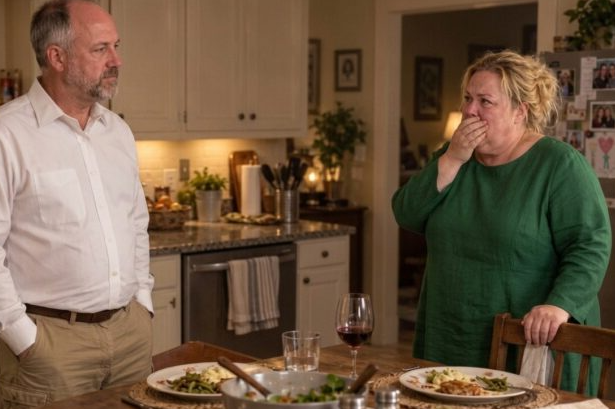
Then one evening over dinner, Frank looked at me with almost no emotion and said:
“I want a divorce.”
I stared at him, convinced I had heard him wrong.
But then he said the words I would never forget:
“You’ve completely stopped taking care of yourself.”
Before I could respond, he admitted there was someone else.
A woman from work.
Younger.
Elegant.
Full of energy.
According to Frank, being with her made him “feel alive again.”
Twenty-seven years of marriage were reduced to a few cruel sentences.
The divorce nearly destroyed me.
For several weeks, I barely slept.
But gradually, something changed.
I stopped asking myself why I had not been good enough.
I began rebuilding the life I had once put aside for him.
Exactly three months after Frank left me, I was sorting through things in the garage when I found an old chest hidden behind several dusty boxes.
Frank and I had both completely forgotten it existed.
I opened it.
And suddenly, I remembered everything.
For a long time, I stood there staring at what was inside.
Then I made a decision.
The next morning, someone began pounding violently on my door.
It was Frank.
His face was red.
His hands were shaking.
And the moment he saw me, he shouted:
“HOW COULD YOU DO THIS TO ME?!”
That was when I realized he had finally found out what I had done…
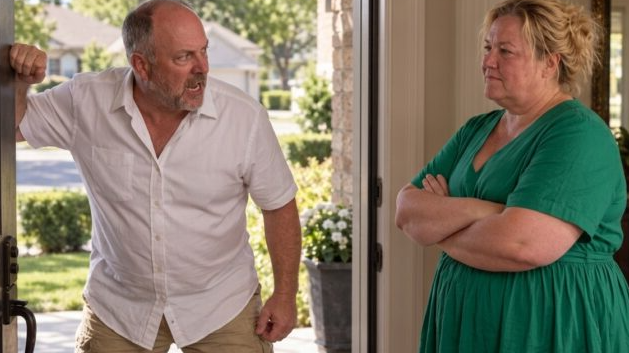
The next morning, Frank was pounding on the front door so hard that the windows shook.
“HOW COULD YOU DO THIS TO ME?!” he shouted the moment I opened it.
For a few seconds, I simply stared at him.
Three months earlier, this same man had stood calmly in our kitchen and destroyed twenty-seven years of marriage while claiming that I had supposedly “stopped taking care of myself.”
Now his face was red, his hair was disheveled, and panic was visible in his eyes.
“What exactly did I do, Frank?” I asked.

“You know exactly what you did!”
I crossed my arms over my chest.
“No. Tell me.”
His jaw tightened.
“You humiliated me. Brittany saw everything. My sister saw everything. My coworkers saw everything too. Even the kids are angry with me now.”
There it was.
It was not guilt.
It was not an apology.
It was shame.
I barely managed to hold back a smile.
But to understand why Frank was standing in front of me in such a rage, you need to know exactly what I had found in that box.
The day before, I had been cleaning out the garage because Frank had left half of his belongings there after moving out.
Behind an old stack of Christmas decorations, I found a dusty box.
On the lid, in Frank’s handwriting, were the words:
“FAMILY RECORDINGS — GRETA’S PROFESSIONAL DOCUMENTS — DO NOT THROW AWAY.”
I almost decided not to open it.
Then I saw my name.
Inside were dozens of old videotapes.
Christmas mornings.
Birthdays.
School performances.
Baseball games.
Family trips.
And underneath them was a folder filled with documents from a life I had almost forgotten.
My old résumé.
Professional certificates.
And a letter offering me a management position that I had received shortly after our daughter was born.
I remembered that opportunity clearly.
I wanted that job.
Frank asked me to turn it down.
“Just until the kids are a little older,” he said. “Your time will come too.”
I believed him.
I stayed home.
The years passed.
Then another opportunity came.
And later, another one.
Meanwhile, Frank’s career kept advancing.
Every promotion meant longer working hours for him and even more responsibilities for me.
I took care of the children.
The bills.
His mother’s doctor appointments.
School projects.
Holidays.
Meals.
Laundry.
Broken household appliances.
Everything that kept our family functioning while Frank became the successful man he wanted to be.
And somehow, after twenty-seven years, he looked at me and decided the problem was that I no longer looked twenty-five.
I sat on the garage floor holding that old job offer in my hands, and for the first time since the divorce, I did not feel sad.
I felt angry.
Then I noticed one of the videotapes.
The label read:
“DINNER FOR FRANK’S PROMOTION.”
I digitized the old recordings.
When my daughter Aria came to visit, we started watching them together.
At first, we laughed.
In one recording, I was holding two sleeping children in my arms.
In another, I was sitting up until midnight sewing Aria’s costume for a school performance.
In another, I was standing beside the field cheering for our son’s baseball team while Frank’s chair next to me sat empty because, once again, he had stayed late at work.
Then the recording of his promotion dinner began.
Frank appeared on the screen — twenty years younger, holding a glass of champagne.
His voice filled the room.
“I want to say something to all of you.”
I saw myself from years earlier, standing beside him and clearly embarrassed by all the attention.
Frank put an arm around me.
“This woman is the reason I have all of this today. Greta believed in me when no one else did. She gave up her own opportunities so that I could build my career.”
I felt a lump rise in my throat.
Then he smiled at the camera and said:
“Your time will come too, Greta. I promise.”
Aria paused the video.
For a moment, we both sat in silence.
Finally, she said softly:
“Dad knew.”
“Yes.”
“He knew what you gave up.”
I nodded.
That hurt more than if he had forgotten.
If he had forgotten, it would have meant he was simply inattentive or irresponsible.
But the fact that he remembered meant something else: he had simply decided that my sacrifice no longer mattered.
That evening, Frank posted a new photo of himself smiling beside Brittany.
The caption read:
“Sometimes, to choose happiness, you finally have to choose yourself.”
Something inside me broke.
I did not insult him.
I did not mention their relationship.
I did not call Brittany any insulting names.
Instead, I created a short video from the old family recordings.
Me — cooking food for dozens of relatives.
Me — caring for his mother after surgery.
Me — present at every school event.
Me — supporting Frank.
And at the end, Frank himself, raising a glass of champagne and telling everyone that I was the reason for his success.
I posted the video with one sentence:
“Twenty-seven years is a very long time. Sometimes old memories remind us what the truth really was.”
And that was all.
By the next morning, relatives had already started leaving comments.
Frank’s sister wrote:
“Greta, everyone in this family knows how much you did for us.”
Our son Atlas wrote:
“I’m proud of you, Mom.”
Aria added:
“You never stopped taking care of yourself. All these years, you carried all of us on your shoulders.”
And it turned out Brittany had seen the video too.
That was exactly why the man standing at my door was so furious.
“She left me!” Frank shouted.
I blinked.
“Brittany?”
“Yes! She says I lied to her. She thinks I portrayed you as a lazy wife who no longer cared about anything.”
“And did you?”
Frank looked at me.
“She said I used you.”
I said nothing.
“She said she doesn’t want to be with a man who let a woman sacrifice everything for him for decades and then blamed her for getting older.”
For the first time, I felt something almost like sympathy for Brittany.
Frank stepped toward me.
“You ruined my life.”
“No, Frank.”
“You knew exactly what would happen when you posted that video.”
“I simply showed the truth.”
“You made me look like a monster!”
I looked straight into his eyes.
“That wasn’t edited.”
He fell silent.
Then the anger slowly began to leave his face.
“Greta… maybe we made mistakes.”
“We?”
He looked away.
“I mean… maybe I handled all of this badly.”
Badly.
Twenty-seven years.
Betrayal.
Divorce.
Humiliation.
And all he could say was that he had simply “handled it badly.”
“Can we talk inside?”
“No.”
His eyes widened.
“We were together for twenty-seven years.”
“You only remembered that after Brittany left you?”
“That’s not fair.”
I smiled slightly.
“I know that sentence very well.”
He lowered his voice.
“What do you want from me?”
For months, I thought I wanted an explanation.
Then I wanted an apology.
Later, revenge.
But standing there in front of him, I realized I no longer wanted any of those things.
“I want you to leave.”
“Greta…”
“You said I had stopped taking care of myself.”
His expression changed.
“I shouldn’t have said that.”
“No. You shouldn’t have thought it.”
I took a step toward him.
“I did not stop taking care of myself, Frank. I simply let my own life wait. I waited for your career to become stable. I waited for the children to grow up. I waited for my turn because you promised it would come.”
He could not look me in the eyes.
“But I’m not waiting anymore.”
I closed the door.
Two weeks later, I updated the résumé I had found in that box.
A month later, I accepted a management position at a small medical clinic.
On my first morning, I stood in front of the mirror.
The woman looking back at me was no longer eighteen.
She was not perfect.
There were wrinkles around her eyes.
The first silver strands were beginning to appear among the rest of her hair.
Her hands showed the marks of several decades of work.
But for the first time in many years, I recognized that woman again.
Frank thought that by leaving me, he would prove that I had lost my value.
Instead, it was only after he left that I finally found it again.
And the box he had forgotten in the garage did not destroy his new life.
It simply reminded me of something I should never have forgotten:
For twenty-seven years, I helped everyone around me become the people they wanted to be.
Now it was my turn.