For as long as I could remember, my daughter had treated her hair like a real treasure.
Not because anyone constantly told her it was beautiful.
And not because she especially loved getting compliments.
Her hair was simply part of who she was.
From the time she was very young, Maja wouldn’t let anyone cut even the smallest piece of it.
Every three or four months, I would sit her on the old wooden chair in our kitchen. I’d drape a towel over her shoulders, and she would watch herself in the mirror with the concentration of a lawyer carefully observing someone sign an important contract.
“Only the ends,” she would always remind me.
“I know.”
“Promise?”
“I promise.”
Even though she had heard that promise dozens of times, she still watched every movement of the scissors carefully.
If I paused for even a second, she would immediately look at her reflection with concern.
“Mom… you didn’t cut too much, did you?”
I would always smile.
“No, Rapunzel. Just half a centimeter.”
Only then would she relax.
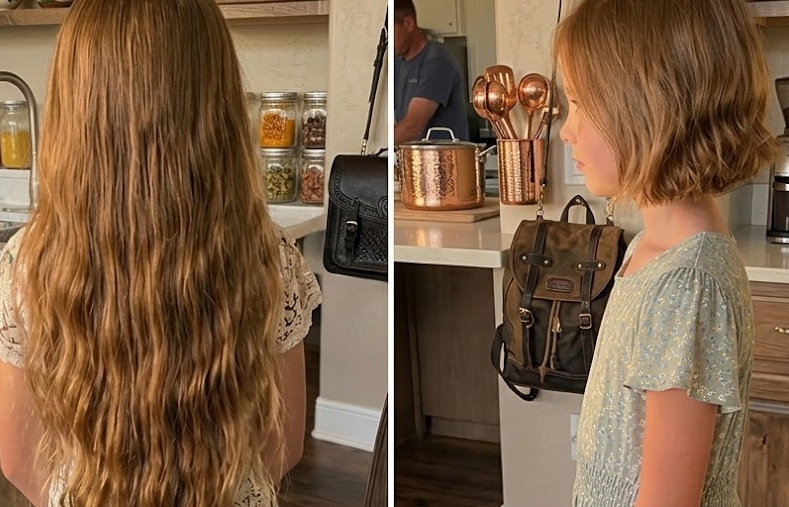
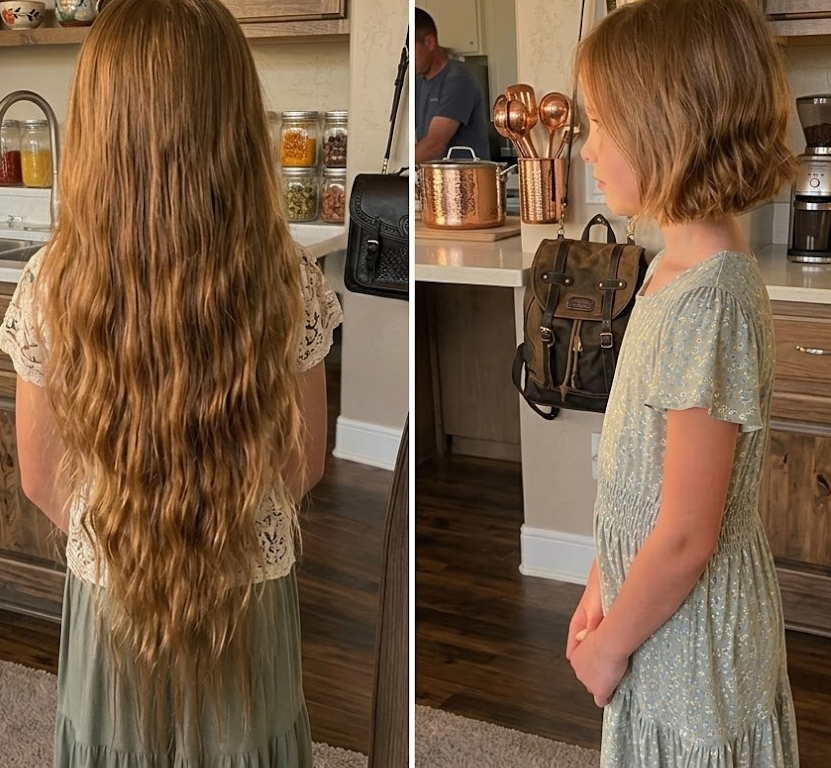
By the time Maja turned ten, her thick, dark hair reached almost to the bottom of her back.
On rainy mornings, it seemed to have a personality of its own.
Washing it took forever.
Drying it probably took even longer.
Every evening after dinner, Maja would sit on the floor between my knees while I patiently brushed through her hair.
I always started at the ends and worked my way slowly upward, untangling one section at a time.
Sometimes she read a book.
Sometimes she told me what had happened at school.
And sometimes we simply sat in silence, enjoying that small moment that belonged only to us.
It became our little ritual.
Her father, Felix, used to joke that our bathroom looked more like a hair salon than a family bathroom.
Brushes, hair ties, conditioners, and detangling sprays were everywhere.
At home, he almost never called her simply Maja.
To him, she was always Rapunzel.
“Rapunzel! Breakfast is ready!”
“Rapunzel, you need to clean your tower!”
“Rapunzel, stop leaving wet towels on the bathroom floor!”
Every time, Maja would pretend to be annoyed.
“Daaad…”
But I always noticed the tiny smile she was trying to hide.
One day, Felix called absentmindedly from the living room:
“Maja, can you go get the mail?”
She had made it halfway down the hallway when she suddenly stopped and turned around with a dramatically serious expression.
“You forgot something.”
“What?”
“The Rapunzel part.”
Felix burst out laughing.
“My mistake. Rapunzel, would you do your father the great honor of getting the mail?”
She gave an exaggeratedly elegant bow and walked outside.
That tiny exchange told me everything.
Her hair wasn’t just hair to her.
It was tied to her confidence.
To the way she saw herself.
And that mattered because school didn’t always treat her as kindly as we did at home.
Maja had never been the kind of child who filled a room with noise.
She was quiet.
Thoughtful.
She was the kind of kid who would rather finish a fantasy novel during recess than run around the playground with everyone else.
She only raised her hand when she was absolutely certain of the answer.
Even if another child accidentally bumped into her, Maja was often the one who said:
“Sorry.”
She thanked the cafeteria workers every day.
She noticed children sitting alone long before most adults did.
Unfortunately, children like Maja often become easy targets.
The bullying had started two years earlier.
At first, everything seemed small.
Comments.
Whispers.
Laughter that stopped the moment a teacher appeared.
One boy called her hair “a tent.”
Another laughed and said Maja looked as if she were hiding behind her own hair.
Some kids especially liked pulling her braid as they walked past.
One day she came home with the braid she had carefully done that morning completely messed up.
“What happened?” I asked.
“Nothing.”
She shrugged.
“It just came undone.”
I believed her.
Until I noticed the hair was tightly twisted and tangled exactly where someone must have grabbed it.
Later, she admitted that someone had pulled her hair during recess while the others laughed.
Felix was furious.
The next morning, we met with her teacher.
We were assured the situation was already being handled.
“We spoke to them.”
A few weeks later, it happened again.
This time another student yanked a hair clip out and ran away laughing.
Another meeting.
Then another.
Eventually, we were sitting in Principal Susan’s office.
She listened carefully.
There was genuine concern in her voice.
“I promise we’ll monitor the situation much more closely.”
Every time, we heard the same assurances.
“We’re monitoring it.”
“We’ve spoken to the students.”
“It won’t happen again.”
Over time, the most obvious behavior really did seem to stop.
No one pulled Maja’s braids anymore.
No one took her hair clips.
Maja stopped crying while doing homework.
She even stopped asking whether she could stay home on days when she had classes with the same kids.
Little by little, I convinced myself things were getting better.
Looking back now, I understand there was one very important thing I didn’t realize then.
Children don’t always stop being cruel.
Sometimes they simply become more careful.
Sometimes they find new ways.
And sometimes the child being targeted decides it’s no longer worth telling adults everything.
I wish I had understood that sooner.
The day everything changed began like an ordinary Tuesday.
I was standing in the kitchen chopping an onion while chicken roasted in the oven.
Soft music played from the speaker on the table.
Every few minutes, I glanced at the clock because Maja’s bus usually arrived at exactly 3:42 p.m.
Then I heard the front door open.
“Maja?” I called.
Normally, she answered immediately.
“Mom, what’s for dinner?”
Or:
“Can I have a snack?”
Or:
“I forgot my homework folder again.”
But that day…
Nothing.
Only the heavy thud of her backpack hitting the wall in the hallway.
I knew immediately that something was wrong.
“Maja?”
Silence.
I wiped my hands on a kitchen towel and walked out.
She was standing completely still near the front door.
Her backpack was still on her shoulders.
It was a warm spring day, but her coat was zipped all the way to her neck, and the hood was pulled so low that I could barely see her face.
My stomach tightened.
Sometimes a mother knows something is wrong before she even knows why.
“Sweetheart…”
She didn’t answer.
She stared at the floor.
I took a step toward her.
“What happened?”
She barely shook her head.
“Why are you wearing your hood inside?”
“Nothing.”
I reached out.
She stepped back.
That tiny movement frightened me more than anything else.
“Maja, please. Look at me.”
Slowly, she raised her face.
Her eyes were red and swollen.
She had been crying for a long time.
“Did someone hurt you?”
She gave the smallest nod.
“What happened at school?”
No answer.
I carefully touched the edge of her hood.
She flinched.
“Maja… what happened?”
Only tears.
I slowly pulled the hood back.
For one brief moment, my brain couldn’t understand what my eyes were seeing.
Her hair…
It was almost gone.
It hadn’t simply been cut short.
It wasn’t missing just a few inches.
The hair that had reached almost to her waist that morning was now uneven, hacked off, and in places barely reached her shoulders.
One side was much shorter than the other.
Jagged sections stuck out in the back.
It looked as if someone had rushed through it with a dull pair of scissors.
My knees gave way.
I dropped to the floor.
“Oh my God…”
Maja started crying even harder.
“Who did this?”
She couldn’t answer.
The fear inside me turned almost instantly into anger.
I remembered every meeting with the school.
Every promise.
Every assurance that things were getting better.
Felix heard my voice upstairs and came running down.
When he saw Maja, the color drained from his face.
“Who did this?” he asked quietly.
Later that day, we were sitting in Principal Susan’s office.
She listened without interrupting.
She didn’t try to defend the school.
She didn’t make excuses.
Finally, she closed her notebook.
“This isn’t a simple joke.”
She looked directly at us.
“This shows how deeply bullying and social isolation have affected these children.”
Then she asked for permission to contact the parents of a boy named Liam.
We agreed.
That afternoon, we returned to the school.
Liam was waiting with his parents, Noella and Duncan.
When he saw Maja, his face lit up.
Noella walked over and hugged her, tears in her eyes.
“Liam talks about you every day.”
Duncan cleared his throat several times.
“We knew you were a kind girl.”
He paused.
“But we didn’t understand how much you had done for our son.”
Maja shook her head.
“I didn’t do anything special.”
Liam looked at her.
“You stayed.”
“You sat next to me.”
“You never made me feel like I was weird.”
Then he added quietly:
“You made me feel normal.”
The room fell silent.
Maja carefully took out a bag containing her cut hair and handed it to Noella.
“I don’t know if it’s enough.”
Noella took the bag in both hands as though it held something precious.
“It will always matter.”
That was when I finally understood.
No one had cut Maja’s hair against her will.
She had cut it herself.
Liam was undergoing cancer treatment and had lost most of his hair.
Some children had started teasing him because of it.
Maja sat beside him every day at lunch.
When she learned that organizations use donated hair to make wigs for children going through treatment, she decided to give away the thing she had protected like a treasure her entire life.
She had done it herself in the school bathroom with an ordinary pair of scissors.
That was why it looked so uneven.
A few days later, specialists from the organization examined the donated hair.
Most of it met the requirements for length and quality.
It wasn’t enough to make an entire wig.
But it could become an important part of one.
That news gave us an idea.
A week later, Felix and I met with Susan again.
“If a ten-year-old girl is willing to give up something she has loved and protected her entire life,” I said, “then I think the adults in our community can do more than just talk.”
Susan smiled.
“I was hoping you would say that.”
Together, we organized a school hair-donation drive.
Professional hairstylists volunteered their time.
A charity partnered with the school.
Families were shown exactly how donated hair could help children undergoing treatment.
Students who couldn’t or didn’t want to donate hair raised money toward making and fitting the wigs.
The response was far bigger than anyone expected.
Three weeks later, the school gym was packed with families.
Parents stood in line with their children.
Teachers volunteered.
Older students donated long sections of hair.
One father had been growing his hair for nearly four years specifically so he could donate it someday.
The music teacher cut almost twelve inches of hair she had been growing since college.
Children who didn’t donate hair made cards filled with messages of support.
The atmosphere wasn’t sad.
It was full of energy and hope.
Maja didn’t cut any more of her hair that day.
Instead, she stood beside Liam at the registration table.
She recorded each donation.
Checked the forms.
Thanked every family.
By the end of the event, enough suitable hair had been collected to make a custom wig for Liam and several more for other children going through treatment.
Almost two months later, Noella called me.
“It’s ready.”
We met outside the school before classes began.
Liam was standing beside his parents wearing his new wig.
It was dark brown.
Soft.
Perfectly fitted.
He kept touching it with both hands.
“I can’t stop,” he admitted.
Then he looked at Maja.
His confidence suddenly faded.
“Do I look weird?”
Maja studied him carefully.
She stepped closer.
Adjusted a small strand that had fallen over his forehead.
Then she smiled.
“No.”
She stepped back.
“You’re still the same Liam I eat lunch with every day.”
His whole face brightened.
They walked into school together.
Side by side.
Other students noticed.
Someone smiled.
Someone waved.
No one laughed.
Susan kept her promise.
The school introduced clearer procedures for reporting bullying.
Teachers received additional training to recognize appearance-related bullying and social isolation.
Students took part in lessons about empathy, bystander responsibility, and the long-term effect of hurtful words.
The school didn’t become perfect overnight.
Children still argued.
They still made mistakes.
But something important changed.
Adults started noticing small signs of pain before they turned into deeper wounds.
A few months later, Maja’s hair had grown below her chin.
One evening, she was sitting on the floor between my knees again while I brushed it.
The ritual that once took nearly twenty minutes now took less than one.
“Not a single tangle,” I joked.
Maja smiled.
“I kind of miss them.”
“I don’t.”
We both laughed.
And as I brushed the final strand, I realized how wrong I had been.
For years, I thought the most beautiful thing about my daughter was her long, dark hair.
Hair grows back.
Compassion leaves a much deeper mark.
The most beautiful thing about Maja had never been her hair.
It had always been her heart.
The day she walked through our door with that uneven haircut, I thought someone had taken something priceless from my child.
I was ready to blame everyone.
Ready to fight anyone who had hurt her.
But the truth was completely different.
No one had taken her greatest treasure.
She had chosen to give it away.
Not because she had stopped loving her hair.
Not because it had stopped mattering to her.
But because she understood something many adults take a lifetime to learn:
the true value of a gift becomes clear when it costs something to the person giving it.
And that day, my ten-year-old daughter reminded me of a simple truth.
Kindness isn’t measured by how much we have.
Sometimes it is measured by how much we are willing to give so another person doesn’t have to feel alone.