For months, while training to become a nurse, my daughter barely spoke to me. Then one day, she confessed that she had secretly married a man more than twice her age.
I had sold my car and worked double shifts for two years so Chloe could study nursing in London. During the first few months, she called me almost every evening, sometimes crying and telling me how much she missed me.
Then something changed.
The calls became less frequent.
Our conversations became shorter.
And whenever I asked about her personal life, Chloe quickly changed the subject.
A week before she was supposed to come home, she unexpectedly sent me a photograph.
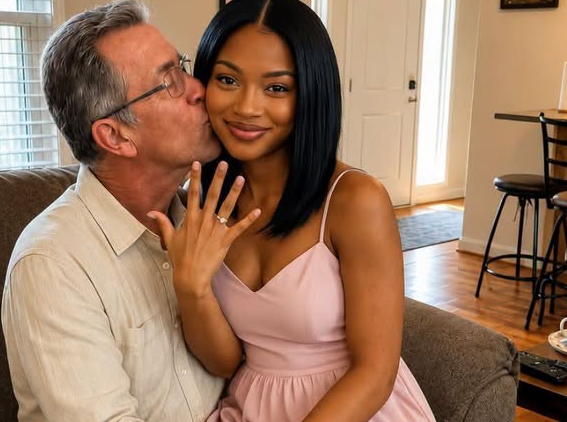
Standing beside her was a man who looked about thirty years older. He had gray hair, deep lines across his face, and one hand resting gently on Chloe’s back.
A minute later, my phone rang.
“Mom, please listen to me before you react,” Chloe said. “We got married two weeks ago. I didn’t tell you because I knew how you would respond.”
I was speechless.
My daughter was twenty-two.
The man she had married, Arthur, was fifty-six.
That night, I barely slept.
My mind kept searching for the worst explanation.
I convinced myself that Chloe had sacrificed her youth and her future for a wealthy older man, perhaps drawn to financial security and an easier life.
But when she came home a few days later, I saw none of the things I had expected.
No expensive clothes.
No jewelry.
No sign of a luxurious new life.
Chloe carried only an old backpack.
She had lost weight and looked exhausted.
We sat across from each other at the kitchen table.
For several minutes, neither of us spoke.
Finally, I couldn’t hold the question back any longer.
“Why him?”
Chloe looked at me, slowly opened her backpack, and pulled out an old folded piece of paper.
She placed it in front of me.
It was an old hospital bill.
“Mom, I didn’t marry him for his money,” she whispered. “I married him partly because of what he did for you ten years ago.”
I stared at the document.

Suddenly, memories I had spent years trying to leave behind came rushing back.
Ten years earlier, I had been treated for cancer.
I was raising Chloe alone, and I couldn’t afford the full cost of my treatment.
I still remembered the day the hospital told me that an anonymous benefactor had paid the remaining balance.
I never discovered who it was.
I thought I never would.
Chloe turned the bill over.
There was a signature on the back.
“I saw the same signature during my internship,” she explained. “It belongs to Arthur.”
That was when I learned that Arthur had spent years funding a program that helped patients who couldn’t afford medical treatment.
I had been one of those people.
My throat tightened.
“So… he helped me survive?”
Chloe nodded.
“Yes. But that isn’t why I married him.”
Then she told me everything.
Arthur was suffering from severe heart failure.
He had three adult children.
As his health deteriorated, a family dispute had developed over how he should be cared for, who should manage his affairs, and where he should spend the remaining months of his life.
Arthur wanted to stay in his own home.
His children believed he should move into a care facility.
Chloe had met Arthur as a patient during her internship.
She cared for him.
She talked with him.
She got to know the person behind the illness.
And one day, she recognized his signature.
When Arthur realized Chloe was the daughter of the woman he had helped so many years earlier, he fell silent.
Then his eyes filled with tears.
“Did your mother survive?” he asked.
“Yes.”
But by then, Arthur’s family situation had already become complicated.
A legal process had begun to determine whether he was still capable of making decisions about his own life and interests.
Arthur was seriously ill and physically weak, but according to Chloe, he understood perfectly well what was happening around him.
After the necessary medical evaluations, it was confirmed that he remained capable of making his own decisions.
Not long afterward, Arthur and Chloe married.
Arthur also gave her power of attorney so she could represent his interests when his health made it difficult for him to handle certain matters himself.
I stared at my daughter, trying to process everything she had just told me.
“You married a seriously ill man so you could stay beside him?”
Chloe was silent for a few seconds.
Then she answered:
“I married a good man because I didn’t want him to face the time when he needed someone most completely alone.”
A week later, I flew to London.
That was when I met Arthur for the first time.
He looked far more fragile than he had in the photograph.
When I tried to thank him for what he had done for me ten years earlier, he stopped me.
He looked at Chloe and then back at me.
“You’ve already thanked me,” he said. “You raised her.”
I didn’t know what to say.
Not long afterward, Arthur’s family dispute reached court.
His children argued that Chloe had taken advantage of a wealthy, seriously ill man.
But medical records, specialist evaluations, and Arthur’s own testimony confirmed that he fully understood the decisions he was making.
At one point, Arthur said:
“I’m seriously ill. That doesn’t mean I no longer understand my own life.”
In the end, his right to make his own decisions was upheld.
Arthur was able to remain in his home and decide how he wanted to spend the time he had left.
Four months later, Arthur died in his own bed.
Chloe and I were beside him.
Shortly before he passed away, he looked at me.
“I’m glad I was able to help you back then.”
Then he turned to Chloe.
“Don’t let other people decide what kind of person you are.”
After the funeral, Chloe and I sat together in silence for a long time.
Finally, I asked the question I had been afraid to say aloud.
“Did you really love him?”
Chloe looked at me.
“Yes. He helped you years before he even knew me. And when I met him, I saw a man who now needed someone to stay beside him. I didn’t want him to spend the final months of his life feeling alone.”
That was when I realized how wrong I had been.
When I first saw my twenty-two-year-old daughter standing beside a fifty-six-year-old man, I immediately created my own version of their story.
I thought it was about money.
Comfort.
Arthur’s wealth.
But Chloe had seen a man who, years earlier, had helped save her mother’s life without asking for anything in return.
And when their roles were reversed and Arthur was the one who needed support, Chloe chose to stay beside him.
For years, I had made enormous sacrifices so my daughter could become a nurse.
Only then did I understand that she had learned something that went far beyond her profession.
She had learned to see the human being where others saw only age, illness, money, and inheritance.